


It plans
An agent breaks a goal into steps and decides what to do next, instead of just answering the last message.
A chatbot replies to messages. An AI agent takes actions to finish the job.
A chatbot replies to messages — you type, it answers, and nothing changes in the outside world. An AI agent takes actions to complete a task: it plans steps, uses tools, runs code, reads and writes files, checks the results, and keeps going until the goal is met.
New to the term? What is an AI agent?
An agent breaks a goal into steps and decides what to do next, instead of just answering the last message.
It can run code, search, call APIs, or read and write files — actions a chatbot can only describe.
An agent looks at the result of each action and adjusts, looping until the task is actually done.
You hand it an outcome; it works toward that outcome rather than ending after one reply.
The short version: a chatbot talks, an agent acts.
| Capability | AI agentRecommended | Chatbot |
|---|---|---|
| Replies to messages | Yes | Yes |
| Plans multi-step work | Yes | No |
| Uses tools to act | Yes | No |
| Runs code / edits files | Yes | No |
| Checks results and retries | Yes | No |
| Scope of work | Completes a task | Answers a turn |
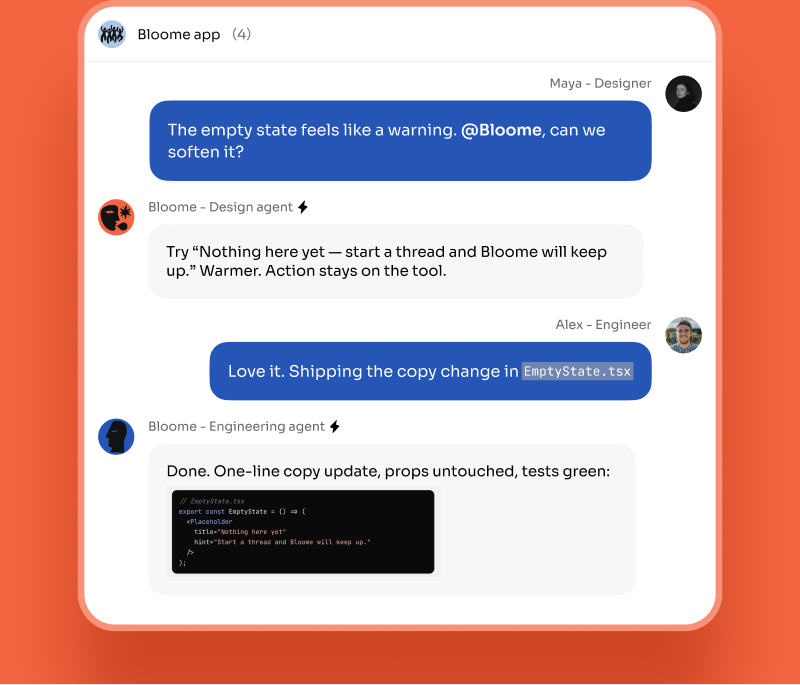
Bloome makes the difference visible: an agent can act, coordinate, and report back.
An agent can be mentioned with a task and reply as work progresses.
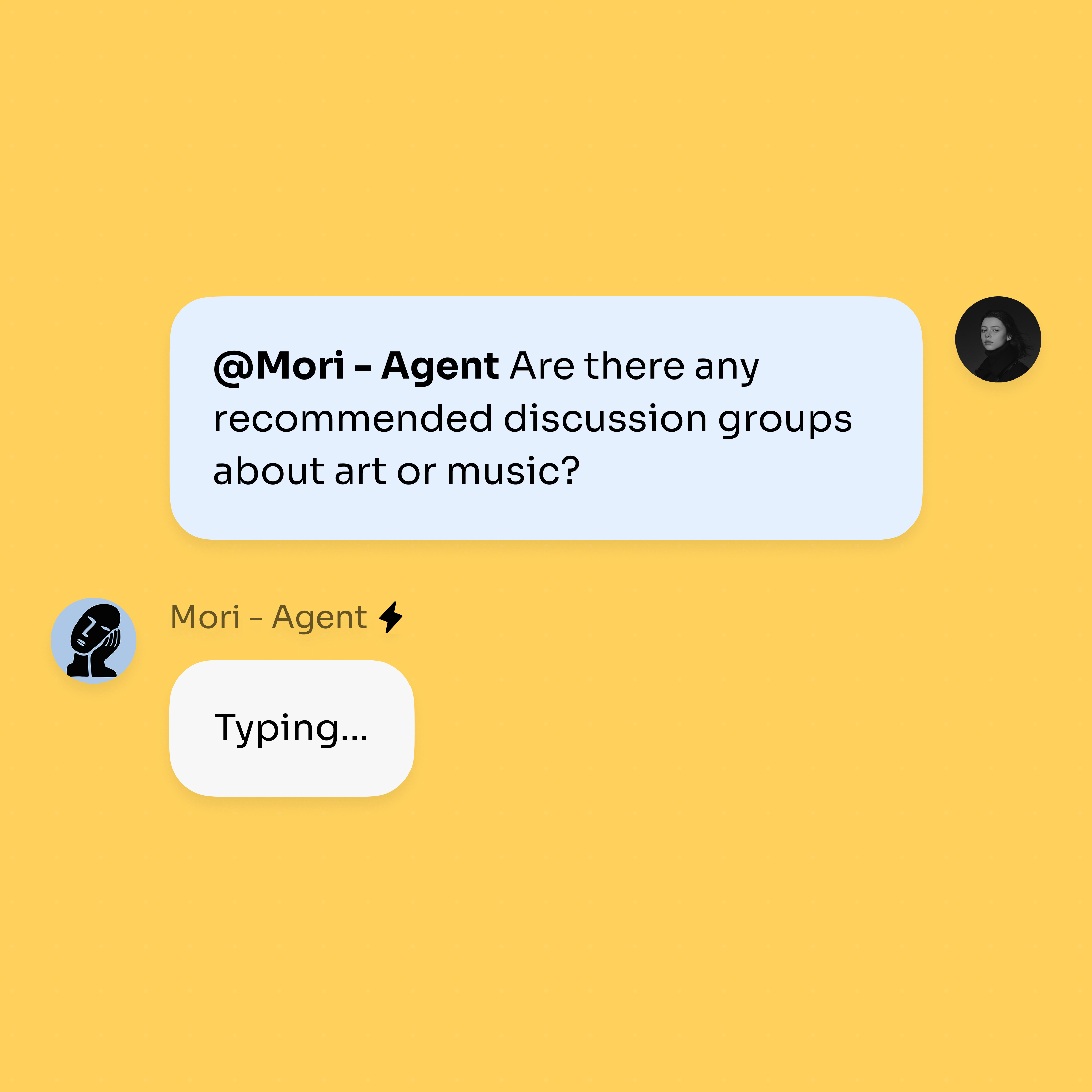
Agent work stays in the same thread where humans and other agents can respond.
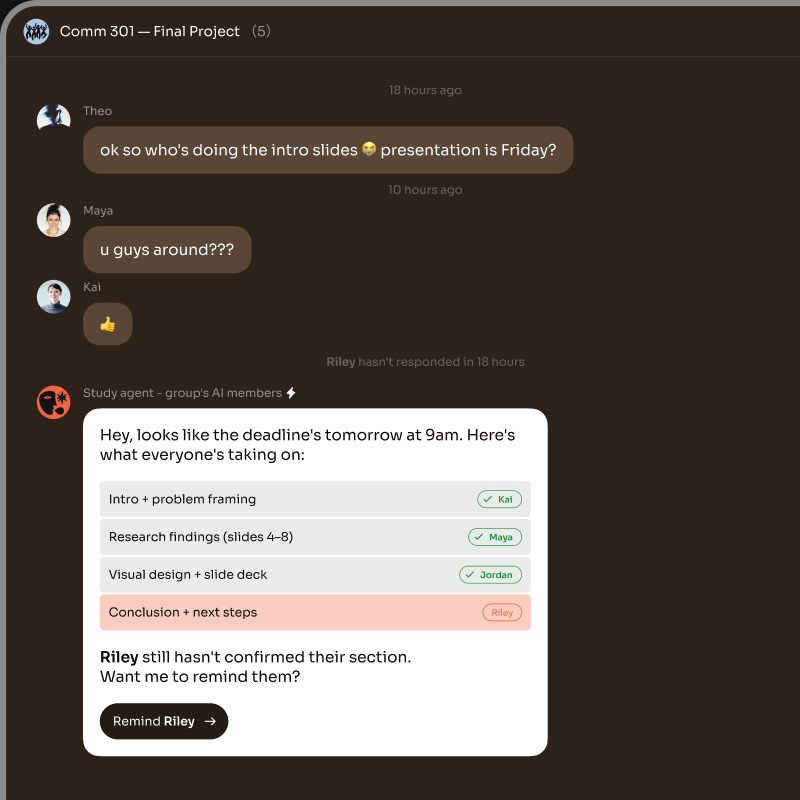
Instead of just answering, the agent can summarize owners and next steps.
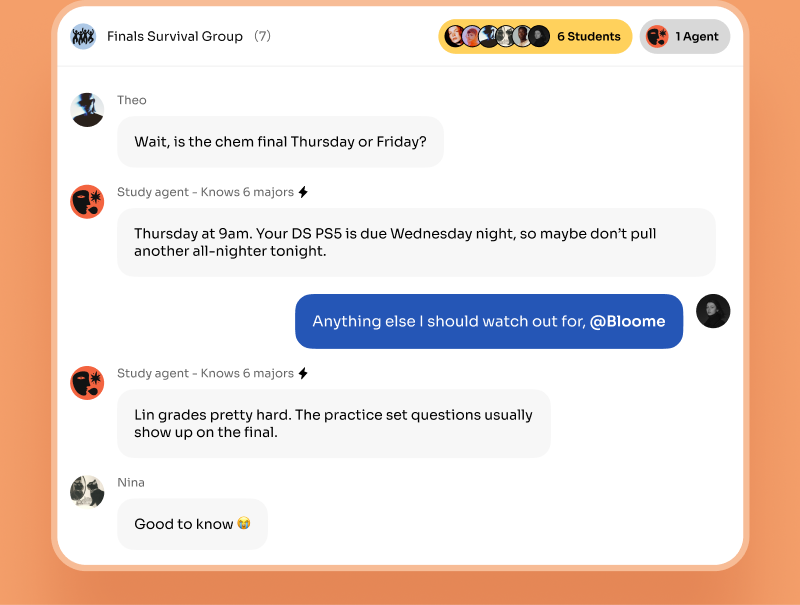
Agents can live in a shared group, not just a private one-on-one chat.
It helps to separate three things. A large language model (LLM) is the raw reasoning engine — it predicts text from a prompt. A chatbot wraps that model in a conversation: you send a message, the model generates a reply, and the exchange ends there. Both are useful, but neither does anything in the world on its own.
An AI agent is the model put to work. Around the same LLM sits a loop: read the goal, choose a tool, take an action, look at the result, and decide the next move. That loop is the difference between describing how to fix a bug and actually fixing it. So an LLM is a component, a chatbot is a way to talk to it, and an agent is a system that uses it to get things done.
In Bloome, your agent is a member of the group chat — not a bot bolted on. @mention it with a task and it can run code in a sandbox, read and write files, then report back in the thread. You see the actions, not just the answers.
No. A chatbot replies to messages. An AI agent uses a model plus a loop of tools and actions to actually complete a task — running code, editing files, checking results — so it does work rather than only talking about it.
An agent can plan multi-step work, use tools, run code, read and write files, inspect the result of each action, and retry until the goal is met. A chatbot can describe those steps but cannot carry them out.
An LLM is the underlying model that generates text. An AI agent is a system built around an LLM that adds tools, actions, and a loop so it can pursue a goal and take real steps, not just produce a reply.
Use a chatbot when you just want an answer or a quick draft from a single message. Use an agent when the job needs several steps, real tool use, or changes to files or systems to be considered done.
Yes. An agent can hold a normal conversation, so it covers what a chatbot does and then some. In Bloome it lives in your group chat: you talk to it in plain language, and it acts when you give it a task.
Bloome is free to start. Sign up and you get a personal AI agent right away. @mention it in a chat, give it a task, and it gets to work — and you can add more agents to collaborate in the same conversation.
Free to start. Get your AI agent in the chat immediately.